The world's best children's football
Goals
150,000 girls in football.
The world's best children's football.
Norway's most important community arena.
Increase to 300 UEFA Playmakers clubs.
Increase the proportion of quality clubs so that 70 percent of all children and young people who play football play in a quality club.
Establish 40 quality clubs+ clubs.
Insights and our strategic initiatives
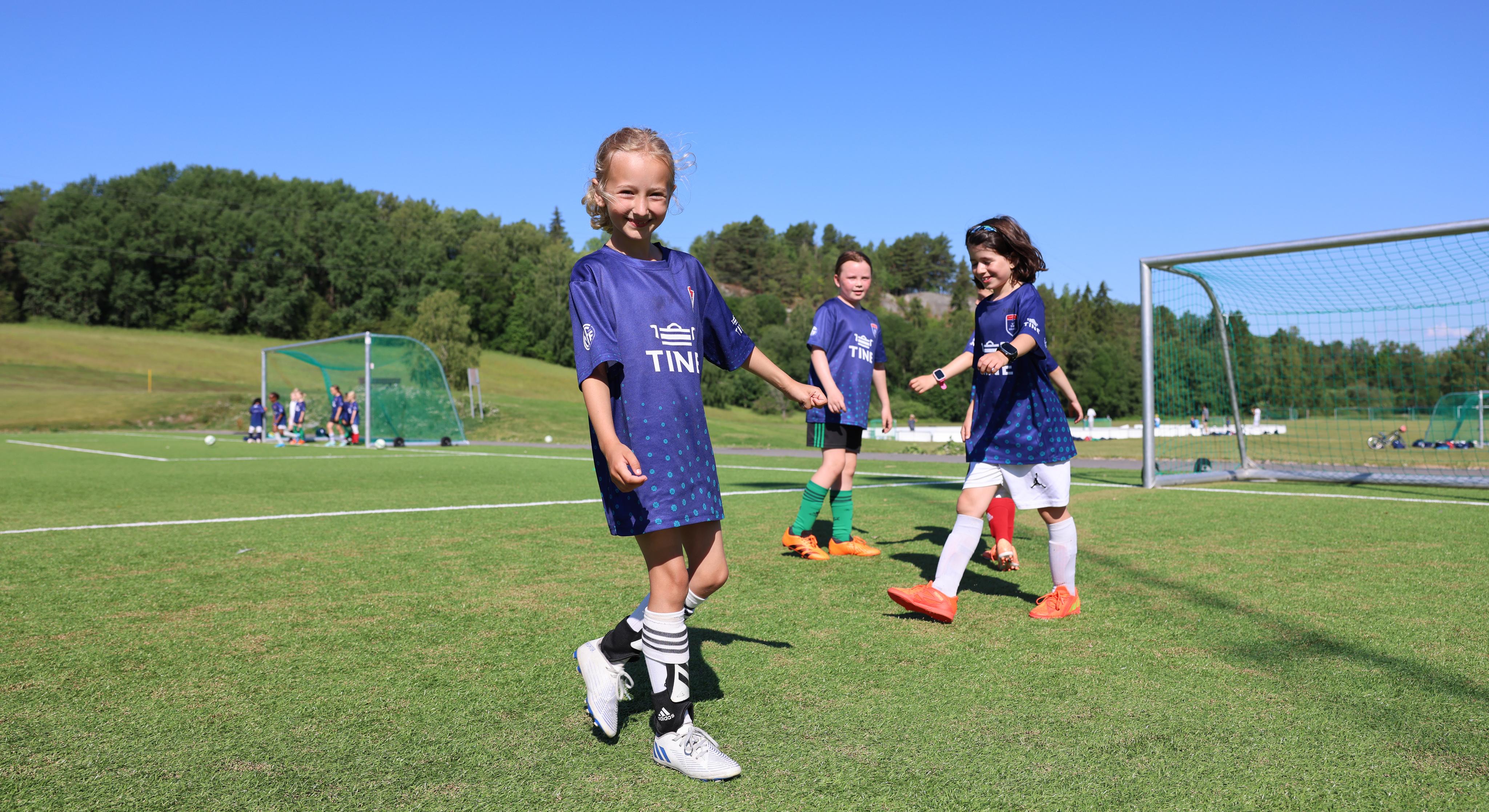
Football should be Norway's most important arena for inclusion and community, and contribute to joy, play, laughter and well-being. Football is by far the largest sport for girls and women in Norway, with 130,000 active members. Norway is a leader in Europe in recruiting girls, and almost one in three players in Norway is a girl. From 2019 to 2024, the number of girls aged six who start playing football has grown by a whopping 86 percent. This is largely due to UEFA Playmakers.
Through quality clubs, a safe environment is offered for players, coaches and managers throughout the country. We emphasize a good start in the club, with broad recruitment and a desire to include as many as possible. We have launched the pilot project Quality Club+, which in the long term can become powerhouses for good recruitment, development and follow-up of girls.
One of the biggest challenges in girls' football comes during adolescence. The annual dropout rate for girls is higher than for boys, and by the age of 19, about 70 percent of players have quit. Lack of motivation, poor development and dissatisfaction with coaches are common reasons for dropout.
The Norwegian club structure forms the very foundation of our activity and the clubs should be a safe home for everyone. Nevertheless, we see that the Norwegian club structure is primarily developed for boys' football. As a result, it does not work as well in girls' football, where there are fewer players. The clubs have to cooperate with neighboring clubs to be able to field teams, which is not always successful.
To solve this challenge, we must improve our cooperation with clubs, offer more low-threshold offers, and more flexible forms of play. At the same time, we have a clear challenge related to too few senior teams on the women's side. To ensure that more girls continue in football as adults, it is crucial to establish a real development ladder in senior football, with several levels and different levels of ambition. Here, the 2nd division clubs play an important role. This will provide room for both those who want to fully invest, and those who want to continue playing at a more adapted level.
In the transition from children's to youth football, greater emphasis must also be placed on retaining girls. Instead of focusing on dropouts, we must actively work to win their interest back. We therefore want to develop a separate, adapted concept for girls in this phase.
The clubs have a key role in this work through closer cooperation with the clubs and to strengthen the follow-up on the girls' side. This applies to, among other things, the player base, training routines, extra offers, as well as match and series offers. The measures in the plan should be adaptable to regional conditions and give the clubs the opportunity to adjust measures if necessary.
Girls' football still lacks diversity, and we are less successful in being an inclusion tool for girls with multicultural backgrounds. To succeed, we need to work more closely with regions, clubs and schools. In this context, experiences from the “Rosa Sko” project can be used in more parts of the country.
Attack
Quality Club+ Girls and women
Quality Club+ (KK) Girls and Women is the NFF's further development of the Quality Club concept, and will strengthen the clubs' work to recruit, develop and retain girls and women in football. The concept provides clubs with a clear framework for creating safe and inclusive development environments, with particular emphasis on coaching competence and good cooperation during adolescence to reduce dropout.
From the age of nine, the KK+ clubs will offer weekly extra activities for the most eager girls. As part of this, we want to collaborate with academic environments to gain insight into which activities are most effective.
Quality Club+ girls and women is now being tested with six clubs. The pilot project will end at the end of 2026, and the experiences will be used in further club development.
Improving diversity in girls' football through collaboration in schools
There are still large differences in who participates in football. In environments with lower incomes and a higher proportion of families with multicultural backgrounds, fewer girls are recruited, while more drop out early.
Barriers such as finances, lack of sports culture, little parental involvement, few role models and poorly adapted arenas are common. This hits girls harder than boys. We also need to increase the representation of women with multicultural backgrounds among coaches, referees, managers and volunteers.
NFF has several existing projects that attempt to solve this challenge, such as the "For Oslo" project, "An inclusive football everyday" and "Løkkefotball".
School investment in areas with disadvantaged living conditions
NFF will further develop a targeted school-based concept with the aim of increasing the recruitment of girls to football in areas with challenging living conditions and a high proportion of people with multicultural backgrounds.
In the Pink Shoes (“Rosa sko”) project, 180 girls from 3rd and 4th grade in Groruddalen participate in weekly football activities. The project shows that the interest in taking part in weekly football activities among girls with multicultural backgrounds is relatively high, and that football offers in schools with all-girls groups have been a key to success. We are working to get more of the girls to go from Pink Shoes activities in school and in AKS, to also take part in ordinary club activities.
We are taking the experiences from the Pink Shoe project and building on a concept that can be used in other major cities, in close collaboration with the clubs.
The measure requires increased funding at the district and central level in order to be implemented.
Midfield
Resource pack for girls in football
To strengthen recruitment, development and well-being among girls in football, the Norwegian Football Federation (NFF) will develop a digital resource package for managers, coaches and players. The toolkit is based on experiences from quality clubs and aims to provide clubs of all sizes with inspiration, knowledge and concrete tools.
The resource package could, for example, contain examples from clubs that are successful with girls' football. This could include information about girls' puberty, menstruation, health, nutrition and injury prevention, and good club structures. The resource package should provide guidelines for club cooperation in youth football, so that more girls receive a stable and safe offer throughout the course, as well as guides for training in smaller groups.
The NFF has received FIFA Women's Development Programme funding to develop this resource pack.
Play with ball from 3 years old
NFF will investigate and develop a new concept for the very youngest children (3-5 years), with the goal of offering age-appropriate, safe and fun activities based on play, movement, balance and all-round motor development – with the ball as a natural and motivating element. The background is that more and more clubs want to start activities for children of this age. To ensure that this happens in a child-friendly and inclusive way, NFF must be at the forefront and provide clear frameworks and guidance for how such activities should be organized.
We also believe that the concept will engage parents, especially mothers, who can later become important resources in the clubs as coaches, team managers and volunteers. The program will be developed in line with Norwegian children's sports regulations.
The concept will be studied and tested in 2027 and launched in 2028.
Five measures to keep girls and women in football
Girls in particular drop out of football during their teenage years, which makes the environments more vulnerable. To ensure that more girls stay in football over time, also into senior football, we must work more purposefully and develop measures that strengthen the offer during their teenage years. Below we have collected five measures.
1. Collaboration between clubs
In areas with small groups of players, cooperation must be encouraged. This applies across year groups within one's own club, or to closer cooperation with neighboring clubs, so that everyone has a team to play on, regardless of where they live or the size of the club.
Separate follow-up for girls' teams in the transition zone between children and youth and youth and senior will also be established, so that more players experience security and continuity in the transition. The club plays a key role here. Resources and a toolbox will be established to assist the clubs in this transition.
2. Re-recruitment of girls in youth football
In the transition from children's to youth football, interest in football among girls must be renewed. This is done through a focus on motivation, mastery and belonging. Special intro packages, welcome activities and low-threshold offers can be developed to create new enthusiasm and community.
The concept can also include your own visual profile and kit, as well as socializing off the field such as access to match tickets for the Toppserien and the women's national team.
The concept starts in 2027 and is prepared centrally by the NFF in close collaboration with the circuit.
3. Flexible game formats and customized competition
In order to keep more girls in football through their youth years, the NFF will facilitate a more flexible and attractive offer in this phase. We will work to raise the status of the game forms with fewer than 11 players. In several places it is challenging to field full teams. Then the girls can instead play 9's, 7's, or 5's matches. The goal is to create more good offers that make it possible for more girls to continue in football longer.
The NFF will also conduct a national study of league structures, cups and competition venues for girls aged 12-15, with the goal of developing a better and more adapted competition offer. The study will, among other things, look at how the most motivated girls can get more and better sporting challenges without compromising safe and stable team environments.
Local adaptations and room for manoeuvre should be emphasized so that the clubs can choose models that contribute to a better football life for the girls.
The work will be carried out in 2026 and 2027.
4. Løkkeball: low-threshold offer
Løkkeball is a low-threshold offer primarily aimed at young people that provides the opportunity to play football and futsal without any skill level, club affiliation or binding membership requirements. Through loop training and loop tournaments, young people can participate when they want, where they want and with whom they want . The concept functions as an additional arena to organized football, with the goal of increasing activity, reducing dropouts and reaching young people who do not want traditional sports. Løkkeball will be experienced as inclusive, social and without performance pressure. In order for the concept to reach girls, we must have an adapted offer. Løkkeball will be launched in 2026.
5. Stimulate more senior women's teams
NFF wants to get more adult women back on the football field. Therefore, we will develop activity concepts and football forms that make it easier to combine football with family life, work and a busy everyday life . The goal is to create inclusive and flexible offers that lower the threshold for participation, strengthen the community and make it possible to play football on your own terms.
Work will start in 2027/2028.
Defense
Quality club, sports plans and sports management
The Quality Club Concept is about strengthening Norwegian football through club development, good organization and structure. The concept ensures that clubs offer a safe and developing environment for players, coaches and managers.
Strengthen sports plans and sports management in girls' football
To ensure a holistic and sustainable development path for girls, the clubs' sports management and sports plans must be strengthened. This means that all quality clubs must have a sports plan that clearly describes goals and practices for girls' football, and that ensures girls equal opportunities for activity, training time, coaching competence and follow-up. The sports manager must be followed up more closely to ensure that the plans are actively used in everyday club life and are prioritized in practice. At the same time, coaching competence in children's and youth football must be strengthened.
Through this commitment, the clubs will over time ensure higher quality, more continuity and a safer development path for all of girls' football.
Extra offer for girls
Strengthened focus on girls in Telenor Xtra Football After School programme
Telenor Xtra (TNX) is a nationwide extra offer for children aged 8-12 that combines football and leisure activities. Experience shows that focusing on girls through TNX has a good effect, both for recruitment and development, and especially for those who want more activity and a safe learning environment. We will therefore work to establish more pure girls' groups to increase recruitment and retain girls longer. Through political, national and regional work, we will work to provide opportunities for free football after school programme (FFO). This can be a major success factor for strengthening recruitment and participation among girls in disadvantaged areas.
Increased focus on UEFA Playmakers
UEFA Playmakers will be continued and integrated as a permanent part of the clubs' recruitment plans. The aim is to recruit more girls, and ensure they have a safe and inspiring first encounter with the sport. The programme will grow to 300 clubs by 2030.
Young people will be used as activity leaders and role models for the youngest, and the clubs will receive support and follow-up from the regions in their work. This is a good way to increase the number of girls with coaching experience.
Girls' Futsal
In futsal, the proportion of girls is somewhat higher than in football in general (34 percent), with a total of 8,581 girls and women participating. As described in the NFF's strategy, we will gain more insight into Futsal as an inclusion tool.
We are looking at various measures to make futsal a natural option for girls . The measures could include reduced prices for participating in futsal for young people, separate futsal festivals in connection with national team matches, as well as separate talent groups and a better club structure.
Priority tasks from the NFF's strategy
Develop measures and a toolkit for clubs and regions to ensure good recruitment and prevent dropouts in girls' football. The work will have an extra focus on girls from minority backgrounds.
Increase expertise and resource use in the regions on player development in girls' football.
Strengthen UEFA Playmakers with an extra focus on recruiting girls with multicultural backgrounds and more female coaches.
Further develop the Quality Club concept for large clubs that can and want more, and for smaller clubs that do not have the prerequisites to be a Quality Club.
The regions should be closer to the clubs and take more strategic and active responsibility for clubs meeting across borders to strengthen cooperation, share experiences and establish sensible practices.
Include, and retain, more children and young people with immigrant or minority backgrounds: work to increase knowledge, facilitate and adapt.
Next page