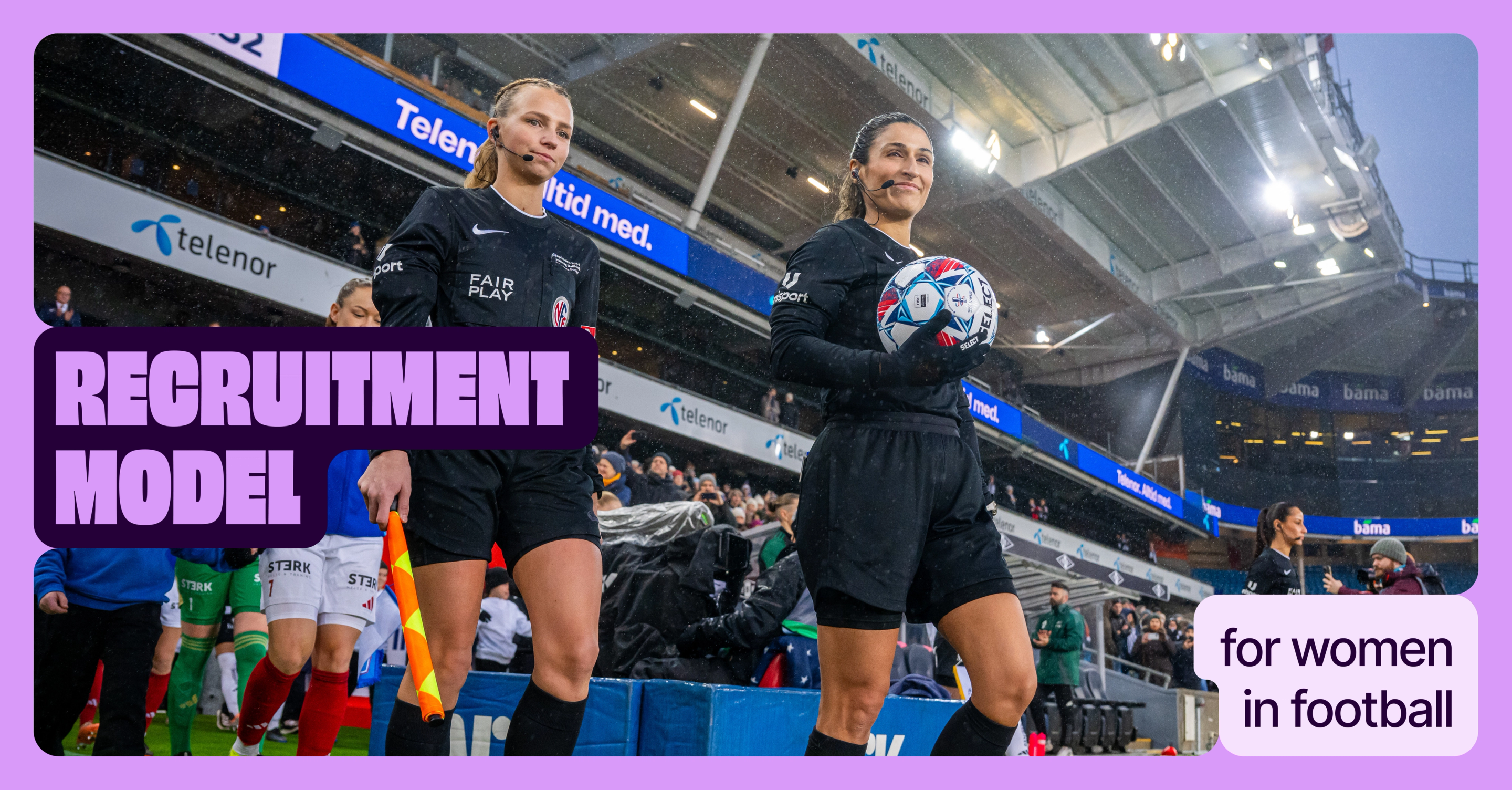
Goals
1,000 new judges (from 4,000 to 5,000) – of which at least 1 in 5 are women.
All teams under the Toppfotball umbrella must have female coaches and managers.
All children's football teams must have coaches representing both genders. For youth football teams, clubs must have a minimum of 25% female coaches.
10,000 participants in the Grass Rat Trainer course each year, of which at least 2,000 must be women.
40% female representation on all district boards, and representation of both genders among district leaders and deputy leaders.
Starting in 2030, women will account for at least 50% of new administrative hires and 20% of coaching hires in the NFF centrally and in the regions.
By 2028, all clubs affiliated with both TFK and NTF must have at least one female coach, either in their development work or affiliated with the A-team of both genders.
By 2030, there should be at least one female coach associated with the A-team in all top clubs.
Key numbers: Women in football
Female coaches
4 714
number
Number of women taking the grassroots coaching course
2 695
+924 since 2022
Female judges
201
8% share of women
Women on club boards
39
Up from 38% in 2024
Female employees in the NFF (central administration)
29
Up from 27% in 2024
Female employees in the regional associations
27
Up from 24% in 2024
Insights and our strategic initiatives
Norwegian football needs more women in all roles, such as coaches, referees and leaders. To improve the gender balance in Norwegian football, the NFF, both centrally and in the regions, must take the lead.
Increasing the number of women in football is not just about representation, but about the quality of the decisions that are made. Norwegian football should have a culture and offer an environment where both girls and boys, women and men, feel equally welcome. We believe that gender equality in club management is a real competitive advantage. When women are severely underrepresented in leadership positions, clubs, regions and associations miss out on experiences, perspectives and insights. Who sits around the table matters. It affects priorities, resource use, level of ambition and the pace of development of women's football.
Many female players are not aware of the opportunities that exist for a life in football. 50 percent of top footballers experience mental challenges with career transition and more than 20 percent are worried about life after their playing career while they are still active. NFF, in collaboration with clubs, NISO and IKS, will facilitate that more female top players combine football and education , and that the transition from playing career to new roles in football is safe and planned. In this way, we also expand the number of women who are available to enter a career in football after their playing career has ended.
Currently, there are only two female head coaches across the Toppserien, 1. divisjon, Eliteserien and OBOS-ligaen. In addition, we have a female head coach for the women's national team. To increase the number of female coaches, we will further develop the national top coach program "More women - better football", through mentoring schemes, club support and national gatherings. The goal is to double the number of female coaches at all levels by 2030.
We will develop more top female referees through a new national refereeing program that combines professional follow-up, physical and mental training, international collaborations and closer follow-up, with the goal of having female referee teams in international championships by 2030.
At the same time, the NFF will ensure that women can stay in football through life stages such as pregnancy and early childhood. The new guidelines for pregnancy and maternity support provide medical, physical and financial support during pregnancy for national team players, as well as automatic contract extensions in the Toppserien. The goal is that no player should have to choose between football and family.
Together, these measures will make football a more attractive workplace for women, ensure greater diversity in decision-making spaces and strengthen Norwegian football through better expertise, broader perspectives and more robust development environments.
Attack
Develop more female coaches
National Women's Top Coaching Program
A comprehensive top coaching program has been established to develop more female coaches from UEFA C to Pro level, called "More Women - Better Football". The program consists of professional gatherings, tailored follow-up, mentoring schemes and study tours.
The program will, among other things:
- Increase the number of female coaches completing UEFA B, A and Pro,
- Ensure a steady pipeline of qualified candidates to top clubs for both genders
- Identify and follow up coaching talents through the regions,
- Provide insight into barriers to recruitment and development.
The goal is to double the number of female coaches at all educational levels and ensure that top clubs have a real supply of competent female coaches by 2030.
NFF has received FIFA Women's Development Programme funds to implement this initiative.
Educate more female coaches across from grassroots
To increase the number of female coaches in Norwegian football, we will recruit more women into the UEFA C education and strengthen cooperation with top clubs on coaching education for top players. Regional professional communities will be established to provide female coaches with a support system and a professional community.
In the NFF's annual club survey, we see that the clubs are largely asking for more support from the circuits and the NFF centrally on how they can increase the number of female coaches and managers. Several circuits have good experiences with offering women free coaching education courses. Some have obtained funds from local partners to implement this.
NFF has received FIFA Women's Development Programme funds to implement this initiative.
Strengthening the career development of top players
The NFF will facilitate the combination of football and education for more top female players, and ensure that the transition from playing careers to new roles in football is safe and planned. The work includes, among other things:
- Establish a national program "Top Players in Education", in collaboration with NISO, TFK, NTF, IKS and research groups.
- Develop flexible study programs in collaboration with universities and colleges, so that top players can more easily combine education and career.
- Create a scholarship scheme for players who are pursuing education, in collaboration with NISO and external partners.
- Arrange annual professional and networking gatherings, including in connection with the women's cup final, with a focus on career planning and continuing education.
The program aims to triple the number of female active players with UEFA C licenses, UEFA B licenses and UEFA A licenses by 2030, and triple the number of female players making a career transition to football.
Midfield
Develop more female referees
National Women's Top Referee Program
In order to strengthen the professionalism and representation of women's football at an international level, the Norwegian Football Federation (NFF) will make a targeted effort to develop more top female referees with the ambition and capacity to referee international championships. The measure includes, among other things:
- Mapping and follow-up of relevant candidates from the Toppserien and 1st division, including both head referees and assistant referees.
- Establishment of a structured development program with close professional follow-up, physical and mental training and exchange of experience with international environments.
- Training camps and training sessions, as well as collaboration with other nations to build experience and resilience.
- Focus on injury prevention, physical capacity and mental strength, through collaboration with a physical trainer and mental trainer.
The goal is for Norway to once again have female referee teams represented in international championships starting with Euro 2029, and for the proportion of women among top referees to increase significantly during the strategy period.
The NFF has received FIFA Women's Development Programme funds to implement this initiative.
Develop more female referees in grassroots game
To strengthen the refereeing profession as a whole, Norwegian football needs more female referees and supervisors. The key is to recruit broadly, follow up closely and create safe development arenas.
The regions should have their own female referees programme and ensure a professional and social environment that makes more people want to become referees. There should also be a clear focus on training more women as supervisors and on establishing regional and national initiatives with female professional support where possible.
NFF is also strengthening the refereeing work in Quality Clubs through clearer requirements, better facilitation and good meeting places for referees. We will also test development projects that use refereeing as an input to solid club development.
Defense
NFF as an attractive workplace for women
To improve the gender balance in Norwegian football, the NFF, both centrally and in the regions, must take the lead.
Several of the measures described in this chapter will mean that more women can be ready for a career in football. In our hiring processes, we will recruit more broadly and work actively to ensure that more women consider and apply for positions.
We will also strengthen our female employees' career development through targeted skills development, including by prioritizing participation in the Norwegian Football Association's football management course and relevant UEFA and FIFA programs. To build a good social environment and create unity, we will hold annual gatherings for female employees.
Equally important is ensuring security and predictability in working life, and we will ensure that women, including those in the toddler phase and in the senior phase, can combine a job in NFF with family life, through flexible solutions and good follow-up.
Pregnancy and maternity support for players
The NFF aims to ensure that no player should have to choose between becoming a parent or continuing their football career. The NFF wants to support players who become pregnant so that they can combine their football career and family life.
In the spring of 2025, Toppfotball Kvinner launched automatic contract extensions for players who become pregnant. If a player is in the 12th week of pregnancy before the end of her last contract year, she will automatically be offered a one-year contract extension, on at least the same terms as the last contract year. This has been agreed upon by the clubs in the Toppserien.
In the fall of 2025, the Norwegian Football Federation (NFF) launched new guidelines to ensure that national team players receive the necessary medical, physical and practical support both during pregnancy and after birth. The scheme provides follow-up throughout pregnancy, facilitation to participate in national team activities to a limited extent, and assistance with a safe and individual return to training and matches.
The guidelines will be followed up and evaluated throughout the strategy period.
Priority tasks from the NFF's strategic plan
Consider licensing requirements for more female employees and coaches in top clubs, and set requirements for female coaches in children's football.
Strengthen recruitment, follow-up and education of female leaders, sports managers, coaches, referees and supervisors.
Implement a comprehensive model for the development of female coaches from UEFA C to UEFA Pro.